The City Where History Is Simply the Street You Walk On
Rome does something to you that no other city manages. The weight of it accumulates as you walk, until you find yourself stopping in the middle of a pavement, looking at a wall that has been standing for two thousand years, trying to understand what that actually means.
 Rome, Italy. Add rome-hero.jpg to your /images/ folder.
Rome does something to you that no other city quite manages. The sheer weight of history, the fact that you can walk down a single street and pass a Roman aqueduct, a Renaissance fountain, a baroque church and a medieval tower within the same hundred metres, accumulates into something that feels almost overwhelming if you let yourself think about it properly. The city has been continuously inhabited for nearly three thousand years and the evidence of all of it is right there on the surface, unhidden and unapologetic.
The layers are what get you. Not any single thing but the combination of them. The Romans built on the Etruscans. The medieval city built on the Romans. The Renaissance built on the medieval. The baroque built on everything that came before. And the result is a city where you cannot walk more than a few minutes in any direction without encountering something that would be the centrepiece of any other European city's heritage, and here is simply the thing on that particular corner.
The Forum at sunrise is the experience I keep returning to in memory. When the light comes in at a low angle across the ancient columns and the city has not yet woken up, you are standing in what was the centre of the world. The place where Roman senators debated, where Caesar walked, where the empire was administered from. And it is completely silent except for the birds. Nothing prepares you for how that actually feels.
Trastevere is the neighbourhood I find myself in by the end of every trip to Rome. It is across the Tiber from the main tourist sites, quieter, more residential, with a different energy to the historic centre. The streets are narrow and cobbled. The buildings are golden and terracotta. The restaurants have tables outside until midnight and the food is better and cheaper than anything near the major sights.
Trastevere has the feeling of a neighbourhood that has been doing the same things for centuries, which in Rome is very probably true. In the evenings it fills with a mixture of Romans and visitors in roughly equal measure, which gives it an atmosphere that feels genuinely local rather than staged for tourism. The Basilica of Santa Maria in Trastevere, with its golden mosaics glowing at night, is one of the most beautiful churches in a city full of beautiful churches and is completely free to enter at any hour.
The Gianicolo Hill, above Trastevere, offers the best panoramic view of Rome from within the city. It is a twenty-minute walk from the neighbourhood and most tourists never make it. Go at dusk. Bring a good camera. The view of the dome of St Peter's rising above the Roman rooftops, with the golden light of the late afternoon falling across everything, is one of the genuinely great views in European travel.
 The Roman Forum at sunrise
 Trastevere at dusk
 The Pantheon
 is the oldest intact building in Rome. It was completed in 125 AD, has been in continuous use ever since, and the engineering that holds its unreinforced concrete dome together has not been surpassed for span-to-thickness ratio by any subsequent construction in nearly two thousand years. These are remarkable facts. The experience of standing inside it at opening time, before the crowds arrive, with the light coming through the oculus and moving slowly across the floor as the earth rotates, is more remarkable than any fact about it.
The oculus is the thing. The circular opening at the top of the dome, open to the sky, through which light enters and rain falls onto a drain in the floor that the Romans installed and that still functions. It is the most extraordinary architectural detail I have encountered in any building anywhere. Stand underneath it. Look up. Give it more time than feels comfortable. It rewards the attention completely.
Rome is not a city to rush. That sounds obvious but most people rush it anyway, moving between the Colosseum and the Vatican and the Trevi Fountain at a pace that does not allow any of them to land properly. The Colosseum deserves a slow morning. The Vatican deserves a full day. The Forum is best at the very beginning or very end of the day when the light is low and the crowds are thin.
Walk everywhere that the distances permit. Rome is larger than it looks on a map but the historic centre is surprisingly walkable and the best things are consistently found between destinations rather than at them. Get lost in the streets between Campo de' Fiori and the Pantheon. Wander through the Jewish Ghetto in the late afternoon. Cross the Tiber at every bridge and see what is on the other side. Rome is a city that gives more to the pedestrian than to anyone moving faster.
 Rome from the Gianicolo Hill at dusk
 Roman street detail
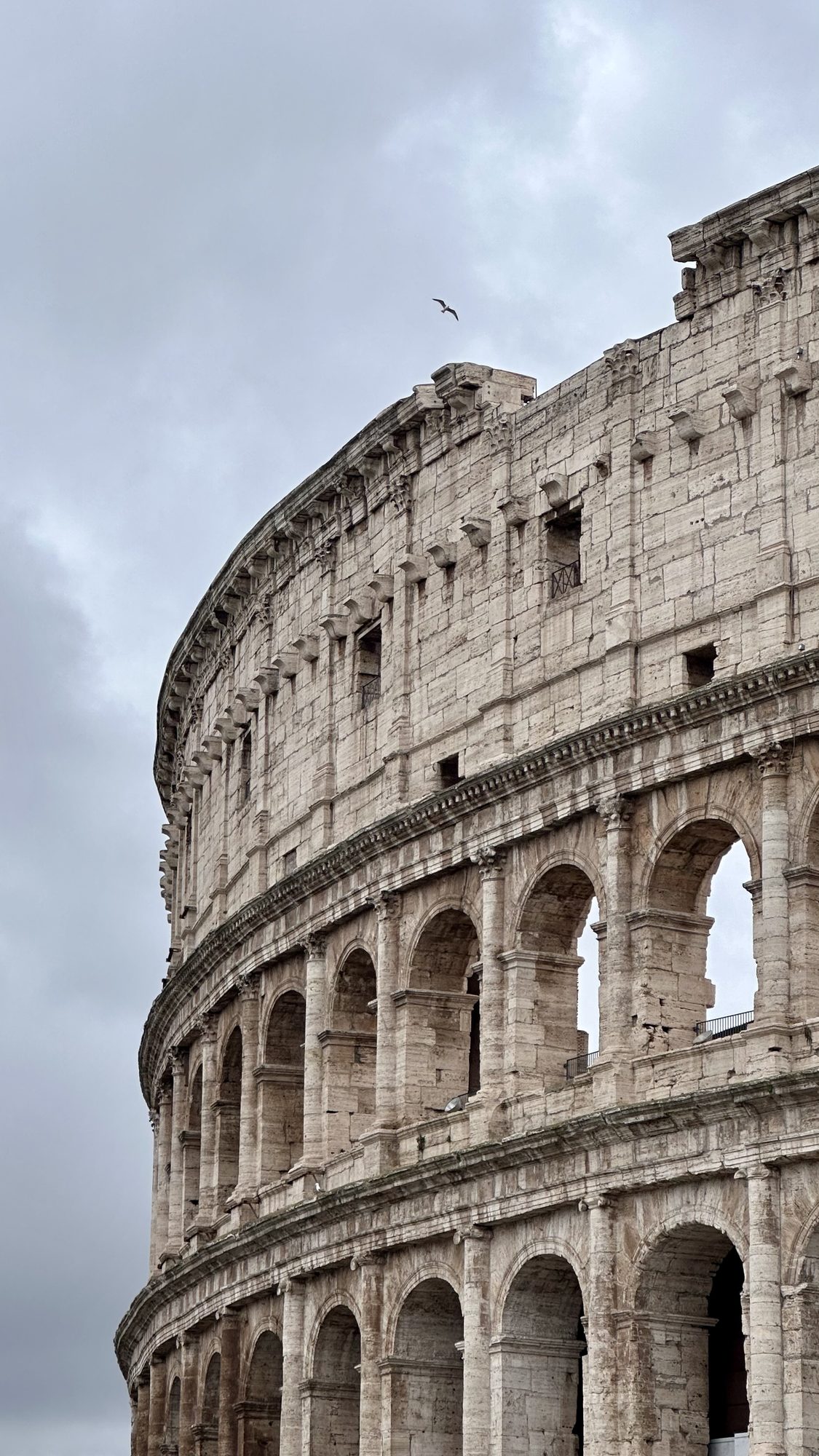 The Colosseum
 Santa Maria in Trastevere at night